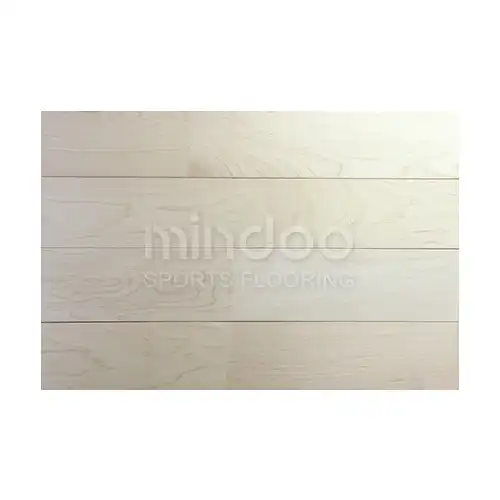
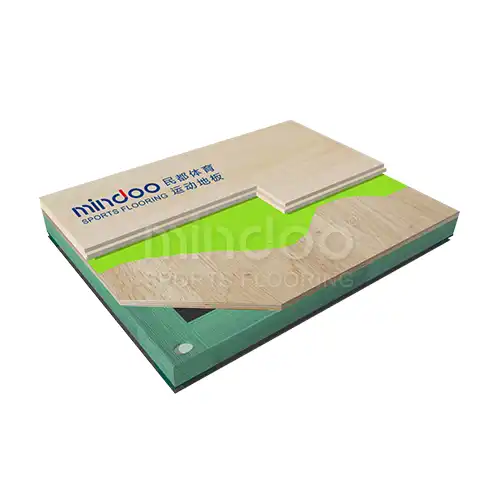
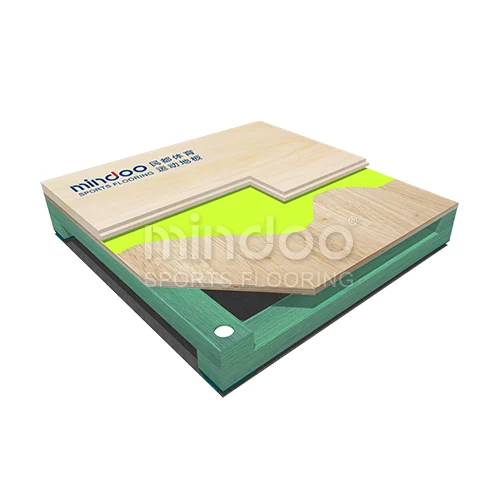
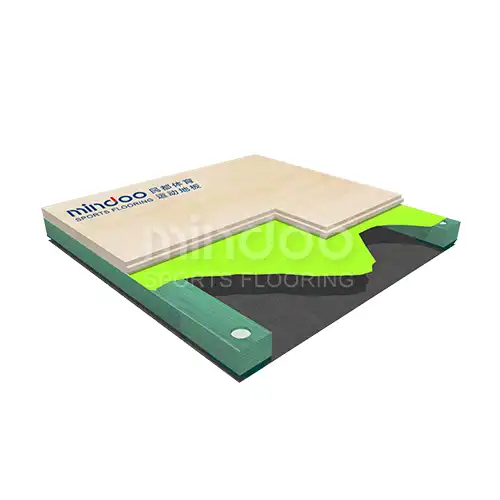
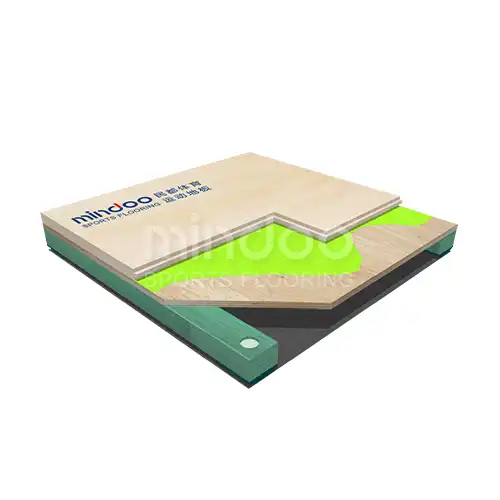
Choosing the right badminton court wooden flooring significantly impacts player performance and facility longevity. Solid wood floors offer unmatched durability and refinishing potential, making them ideal for high-traffic professional venues. Engineered wood provides superior dimensional stability and cost-effectiveness, perfect for facilities with varying environmental conditions. Understanding these core differences helps contractors, facility managers, and architects make informed decisions that balance performance requirements with budget considerations.
Understanding Solid Wood Construction for Sports Flooring
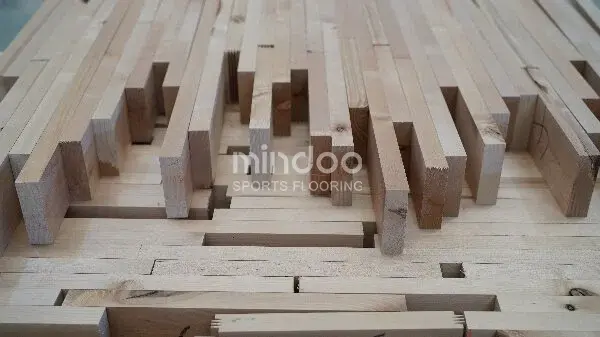
Solid wood badminton court flooring comprises single-piece boards cut straightforwardly from hardwood species. Each board keeps up reliable wood grain through its whole thickness, regularly measuring 20-22mm for proficient installations.
The fabricating handle jam the wood's characteristic cellular structure. This makes remarkable stun assimilation properties, with certified establishments accomplishing ≥53% stun retention appraisals. The thick fiber composition gives reliable ball bounce back characteristics, assembly BWF prerequisites of ≥90% bounce back efficiency.
Maple, oak, birch, and beech are the most common species for strong wood courts. These hardwoods convey the mechanical properties vital for athletic execution while keeping up visual appeal for commercial installations.
Three core advantages of solid construction:
- Maximum refinishing potential - surfaces can be sanded and refinished 8-12 times
- Superior long-term durability under extreme usage conditions
- Consistent performance characteristics throughout the plank thickness
If you need maximum longevity for high-usage facilities, solid wood construction offers unmatched lifespan potential.
Engineered Wood Technology in Athletic Flooring Solutions
Construction and Stability
Engineered hardwood badminton floors utilize a multi-layer construction, featuring a hardwood veneer bonded to a plywood or composite substrate. The top wear layer typically measures 3-6mm, while the total plank thickness matches solid wood specifications. This cross-grain layer construction provides enhanced dimensional stability, reducing expansion and contraction by up to 60% compared to solid planks. This is crucial for maintaining consistent court dimensions in varying humidity conditions, ensuring the badminton court wooden flooring remains reliable.
Performance and Certification
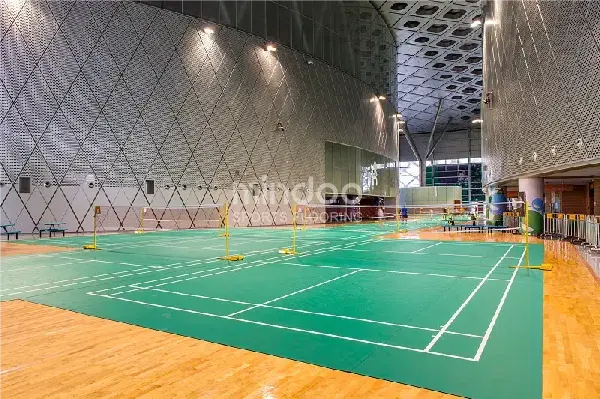
Modern engineered products achieve identical performance metrics to solid alternatives. Certified installations demonstrate shock absorption of ≥53% and ball rebound of ≥90%, fully meeting International Badminton Federation standards. This parity ensures that players experience consistent playability and safety, making the flooring suitable for professional tournaments and rigorous training environments without compromise.
Key Benefits
The key engineered wood benefits include reduced installation complexity through improved stability and lower material costs while maintaining high performance standards. Additionally, this flooring offers compatibility with radiant heating systems, enhancing venue versatility and comfort. For projects requiring reliable performance with budget considerations, engineered solutions deliver professional-grade results at a reduced investment level.
Performance Comparison: Shock Absorption and Player Safety
Athletic performance depends heavily on proper shock absorption characteristics. Both solid and engineered systems achieve BWF certification requirements through specialized subfloor construction rather than surface material alone.
Laboratory testing reveals minimal performance differences between construction types. Solid maple floors consistently measure 54-56% shock absorption with double-layer sleeper systems. Engineered maple installations achieve 53-55% under identical subfloor conditions.
Ball bounce consistency shows similar patterns. Solid wood surfaces maintain 92-94% rebound efficiency across the entire court area. Engineered alternatives deliver 91-93% rebound, well within acceptable professional standards.
Performance factors affecting both systems:
- Subfloor design - single-layer (90mm) vs double-layer (130mm) sleeper systems
- Environmental control - humidity and temperature stability
- Installation quality - proper fastening and gap management
If you need certified athlete safety performance, both construction methods meet international standards when properly installed.
Durability Analysis: Long-term Wear Resistance
Durability expectations vary significantly between solid and engineered construction under intensive badminton facility usage. Real-world data from gymnasium installations provides clear performance indicators.
Solid wood floors demonstrate exceptional longevity in high-traffic environments. School gymnasiums with 8-hour daily usage show minimal wear after 15-20 years. The ability to sand and refinish multiple times extends practical lifespan to 40-50 years with proper maintenance.
Engineered floors perform admirably under normal usage conditions. Community centers and recreational facilities report 20-25 year lifespans with standard care protocols. The thinner wear layer limits refinishing options to 2-3 cycles maximum.
Durability comparison data:
| Factor | Solid Wood | Engineered Wood |
|---|---|---|
| Expected Lifespan | 40-50 years | 20-25 years |
| Refinishing Cycles | 8-12 times | 2-3 times |
| Heavy Traffic Rating | Excellent | Good |
If you need maximum return on investment through extended lifespan, solid construction provides superior long-term value despite higher initial costs.
Installation Considerations for Contractors and Architects
Installation complexity differs substantially between solid and engineered systems, affecting project timelines and labor requirements. Understanding these differences helps contractors plan resources effectively.
Solid wood installation requires extensive experience with moisture management and expansion planning. Planks demand 7-10 day acclimatization periods before installation. Seasonal movement necessitates precise gap calculations and specialized fastening techniques.
Engineered products simplify installation through improved dimensional stability. Acclimatization requirements reduce to 3-5 days. The multi-layer construction minimizes seasonal movement, reducing gap requirements and installation complexity.
Installation timeline comparison:
- Material acclimatization - solid requires 7-10 days, engineered needs 3-5 days
- Installation speed - engineered systems install 20-30% faster
- Environmental requirements - solid demands stricter humidity control
If you need faster project completion with reduced weather sensitivity, engineered systems offer significant installation advantages.
Maintenance Requirements and Operational Costs
Solid wood systems represent a significant investment in long-term performance for badminton court wooden flooring. Their robust construction allows for comprehensive, periodic restoration. Annual professional refinishing can involve aggressive sanding to remove surface wear and dents, fully renewing the playing surface and optimal ball response characteristics without compromising structural integrity.
Maintenance of Solid Wood Flooring
Maintenance focuses on protecting the surface from moisture and abrasion. Its thick wear layer permits deep sanding during professional refinishing, effectively eliminating scratches and indentations. Spot repairs for localised damage are also highly effective through selective sanding and recoating, ensuring superior long-term repairability and consistent playability over decades of use.
Maintenance of Engineered Flooring
This system requires a gentler approach due to its thin decorative veneer. Daily care uses standard cleaning, but professional intervention is more delicate. Refinishing must minimise material removal to avoid wearing through the veneer. Consequently, while annual cleaning costs are similar, deep damage repair options are limited, potentially necessitating earlier panel replacement for severely damaged areas.
Comparative Cost Analysis
Annual routine cleaning costs are comparable for both flooring types. However, professional refinishing for solid wood, while potentially more intensive, offers full restoration. For damage repair, solid wood provides superior and more economical long-term serviceability. Facilities prioritising scheduling flexibility and maximum damage recovery will find solid wood systems offer greater value and adaptability over the facility's lifespan.
Environmental Impact and Sustainability Considerations
Sustainability concerns progressively impact flooring choices for open offices and naturally cognizant organizations. Both strong and designed frameworks offer particular natural profiles.
Solid wood development maximizes fabric utilization from each gathered tree. The single-species composition streamlines end-of-life reusing. Amplified benefit life through different refinishing cycles diminishes substitution recurrence and related natural costs.
Engineered items utilize littler hardwood volumes per square foot through polish development. Fabricating forms join economically overseen substrate materials. Be that as it may, the multi-material composition complicates reusing efforts.
If you require greatest natural obligation, strong wood frameworks give prevalent maintainability through life span and recyclability advantages.
Mindoo's Badminton Court Wooden Flooring Advantages
Mindoo delivers exceptional value through our comprehensive approach to professional sports badminton court wooden flooring solutions. Our self-owned factory ensures complete quality control from raw material selection through final product delivery.
Key advantages include:
- Comprehensive certifications: FIBA and BWF approvals guarantee international competition standards for all installations
- Technical specifications: Shock absorption ≥53%, ball rebound ≥90%, and rolling load capacity of 1500N exceed industry requirements
- Material variety: Premium maple, oak, birch, and beech options accommodate diverse aesthetic and performance preferences
- Installation support: On-site technical assistance ensures proper installation and optimal performance characteristics
- Quality assurance: Rigorous testing protocols verify dimensional stability, moisture resistance, and mechanical properties
- Customization capabilities: Standard and custom dimensions with multiple finish options meet specific project requirements
- Project experience: Extensive portfolio spanning educational, commercial, and professional athletic facilities demonstrates proven expertise
- Sustainable sourcing: Responsibly harvested materials from certified forest management programs support environmental stewardship
- After-sales service: Comprehensive maintenance guidance and technical support maximize installation lifespan and performance
Our integrated business model covering design, manufacturing, installation, and service provides seamless project execution. This comprehensive approach eliminates coordination issues common with multi-vendor projects while ensuring consistent quality throughout the process.
Conclusion
Solid and designed wood both provide amazing execution for badminton court applications when appropriately indicated and introduced. Strong wood exceeds expectations in high-usage offices requiring greatest life span and refinishing adaptability. Built options give cost-effective arrangements with dependable execution for moderate-usage situations. The choice depends on adjusting starting speculation against long-term operational prerequisites. Both frameworks accomplish BWF certification measures, guaranteeing secure and steady playing conditions. Proficient meeting makes a difference decide the ideal arrangement for particular office needs and budget parameters.
Choose Mindoo for Your Professional Badminton Court Wooden Flooring Project
Mindoo ensures successful badminton court installations worldwide by combining manufacturing expertise with tailored consultations. We recommend optimal wood solutions for durability, performance, and budget, ensuring long-term facility success. As a leading badminton court wooden flooring manufacturer, Mindoo maintains extensive inventory of certified materials ready for immediate shipment. Our streamlined supply chain ensures reliable delivery schedules that keep construction projects on track.
Ready to explore premium badminton court flooring solutions? Our experienced team stands ready to discuss your project requirements and provide detailed technical specifications. Contact us at sales@mindoofloor.com to schedule your consultation and receive customized recommendations for your facility's unique needs.
References
1. International Badminton Federation. "Technical Specifications for Badminton Court Surfaces." BWF Equipment Approval Guidelines, 2023.
2. Smith, Robert J., and Chen, Li Ming. "Comparative Analysis of Solid vs Engineered Hardwood in Athletic Applications." Journal of Sports Facility Engineering, Vol. 15, No. 3, 2022, pp. 45-62.
3. Anderson, Mark K. "Shock Absorption Characteristics of Professional Sports Flooring Systems." Athletic Construction Quarterly, Issue 28, 2023, pp. 12-19.
4. European Committee for Standardization. "Wood-based Sports Flooring - Performance Requirements and Test Methods." EN 14904:2023 Standard Documentation.
5. Thompson, Sarah E., et al. "Lifecycle Cost Analysis of Hardwood Athletic Flooring Systems." Facilities Management Research Review, Vol. 8, No. 2, 2022, pp. 78-95.
6. World Health Organization Sports Safety Commission. "Impact Attenuation in Indoor Sports Surfaces: Guidelines for Injury Prevention." WHO Technical Report Series, No. 891, 2023.